The Dawn of Autonomous Marketing
Picture this scenario: It’s a typical Tuesday morning, yet your marketing team isn’t frantically pulling performance dashboards, manually adjusting campaign budgets, or painstakingly segmenting customer databases. Instead, your AI systems have already processed overnight metrics, redistributed spending toward high-performing channels, generated fresh creative concepts, and delivered strategic recommendations—all while you were still asleep.
This isn’t science fiction or some distant future prediction. It’s happening now, and it’s fundamentally transforming how marketing organizations operate. For too long, we’ve been attaching AI capabilities to outdated processes—like placing a rocket engine on a horse-drawn carriage. Impressive in theory, but ultimately ineffective.
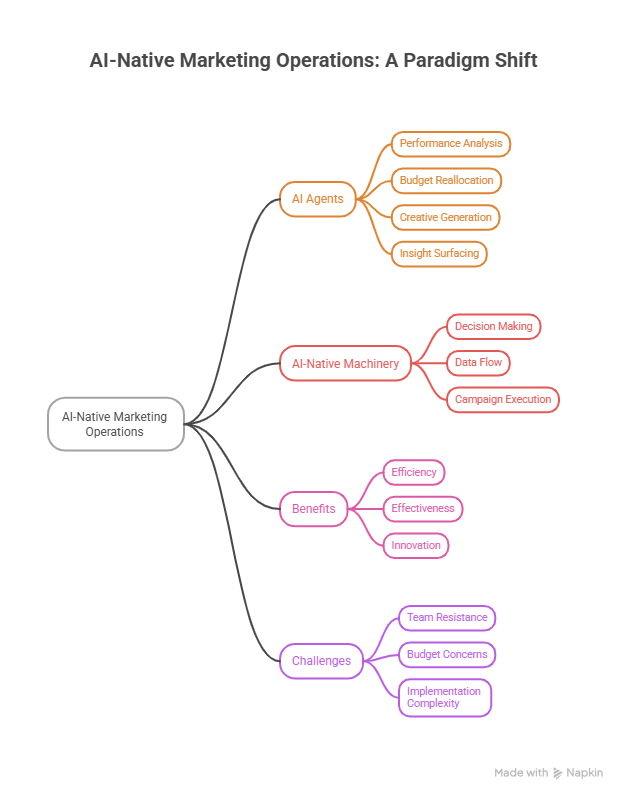
AI-native marketing operations represent a complete departure from this approach. It involves reconstructing your marketing infrastructure with artificial intelligence woven into the very core of how decisions emerge, data circulates, and campaigns execute.
So what does this transformation actually entail? Why should it matter to you? And crucially, how can you navigate this transition without triggering team resistance or draining your resources? Let’s explore.
Defining AI-Native Marketing Operations
AI-native marketing operations signal a fundamental transformation. In this framework, artificial intelligence isn’t simply an accessory—it’s the foundational operating system. It serves as the central nervous system connecting strategy, implementation, and refinement into an ongoing, self-enhancing cycle.
Traditional Marketing Approach:
You develop an idea, brief creative teams, they produce materials, you launch, await outcomes, analyze data, and then restart the entire laborious process. It’s sequential and sluggish.
You employ AI solutions to accelerate individual steps within that sequential process—generating email subject lines here, producing visuals there. Localized efficiency rarely translates to organization-wide impact.
Ai Native Marketing Operations :
You articulate your business objective—for instance, “boost trial registrations among enterprise CFOs during Q3″—to a coordinated network of specialized AI agents. These systems autonomously examine data, construct audience segments, generate and evaluate creative variants across multiple channels, dynamically optimize spending allocation, and extract insights to guide subsequent iterations. It’s continuous, self-directed, and massively scalable.
The key distinction is "native." It's integral, not superficial.
Why Your Current AI Strategy Likely Falls Short
Here’s an uncomfortable reality: most marketing departments are pouring resources into AI yet seeing negligible returns. Gartner reports that approximately 95% of enterprise generative AI initiatives have failed to produce measurable financial outcomes. Why?
The fundamental issue is what I call the "layered approach."
The fundamental issue is what I call the “layered approach.” Organizations are simply stacking new AI technologies onto outdated, disjointed workflows. Capgemini perfectly captures this dilemma, observing that many brands “rushed into AI adoption anticipating immediate results, without any intention of establishing an AI-native marketing trajectory.” The outcome? An increasingly complex, burdened ecosystem requiring even greater human oversight.
You cannot repair a flawed process by automating it. You simply accelerate the production of flawed outcomes.
The Three Pitfalls of AI Implementation
The Technology Obsession:
Acquiring more AI point solutions without proper integration or addressing underlying data infrastructure. Marketing teams are adopting AI agents faster than they’re developing the operational maturity to support them.
You cannot repair a flawed process by automating it. You simply accelerate the production of flawed outcomes.
Conducting endless small-scale experiments that never achieve organizational scale. Genuine transformation demands moving from isolated tests to enterprise-wide system architecture.
You cannot repair a flawed process by automating it. You simply accelerate the production of flawed outcomes.
Anticipating that existing teams will spontaneously become AI experts. Snowflake’s experience illustrates this well; initially, merely 11.6% of their marketing staff felt competent using AI. They needed to cultivate trust, proficiency, and a shared framework first.
The Four Pillars of AI-Native Marketing Operations
Achieving genuine AI-native status requires reconstructing your operations around four interdependent pillars. This framework distinguishes marginal efficiency improvements from true strategic advantage.
1. Unified Data Infrastructure
AI performs only as effectively as the data it accesses. If your information remains trapped in isolated systems—customer relationship management here, web analytics there, advertising platforms everywhere—your AI agents essentially operate blindly. AI-native marketing operations demand a consolidated, decision-ready data foundation. This requires dismantling data silos, ensuring information quality, and implementing robust governance protocols. This represents the fundamental layer upon which everything else depends.
This is where transformation truly occurs. Agentic AI refers to systems capable of independently executing multi-step tasks and continuously adapting based on interactions. Rather than a single AI tool awaiting human activation, you deploy specialized agent teams:
A Data Agent continuously tracks performance fluctuations
A Creative Agent generates and evaluates asset variations
An Orchestration Agent coordinates activities across channels and adjusts strategies
3. Redesigned Human-AI Collaboration
Becoming AI-native isn’t about eliminating human roles—it’s about enhancing them. The objective is to automate mundane, repetitive work so your team can concentrate on high-level strategy, creative vision, and sophisticated decision-making. This demands fundamentally restructuring workflows to determine how humans and AI complement each other’s capabilities. Your marketing operations team shifts from tactical execution to strategic oversight, governance, and AI system refinement.
4. Continuous Learning and Optimization
In an AI-native framework, marketing becomes a “performance accelerator.” Insights don’t merely accumulate in quarterly reports; they immediately feed back into the system to influence subsequent decisions. Experimentation no longer requires dedicated innovation budgets—it becomes embedded in daily operations. The system grows more intelligent and effective with each cycle.
Real-World Implementation Stories
Theory provides direction, but practical examples offer genuine insight. Let’s examine how two distinctly different organizations are implementing AI-native marketing operations.
Snowflake: Cultivating Trust Before Technology
Snowflake’s marketing organization likely resembled yours in early 2025—some team members experimenting with AI, but lacking coordinated strategy. They established a Marketing AI Council in January 2025, comprising eight individuals from demand generation, content, analytics, and operations. However, they didn’t begin with training.
Instead, they devoted six weeks to developing content guidelines, addressing compliance requirements, and answering fundamental questions. They constructed the infrastructure of trust, protocols, and shared language before implementing any technology.
By April 2025, they hosted their inaugural Marketing AI Day—a practical event where marketers learned to utilize Snowflake’s proprietary AI tools. The outcomes were remarkable. By mid-2025, 87% of their North American marketing organization actively used AI. Today, an impressive 93% of their marketers employ AI tools daily.
The takeaway: AI-native marketing operations represent as much a cultural and change-management challenge as a technical one. Your people must accompany you on the journey.
Wix: Coordination Over Isolation
Paula Mejia, VP of Marketing at Wix, articulates the challenge perfectly: you must "construct the railway while the train is moving." For Wix, becoming an AI-native marketing team demands coordinated, cross-functional adoption of tools rather than isolated experimentation.They're not simply employing AI for content generation; they're reimagining their entire SEO approach for a landscape where AI overviews and language models dominate discovery. They're prioritizing "zero-click SEO," emphasizing consistent terminology, semantic precision, and earned media to ensure visibility in AI-driven search results. This represents a comprehensive, orchestrated strategy touching every organizational facet.The takeaway: AI-native transformation cannot occur in isolation. It requires coordination across teams, technologies, and processes.Your Practical Roadmap to AI-Native TransformationYou're convinced. You want to progress toward AI-native marketing operations. But where do you start? The undertaking may seem daunting, but it doesn't have to be.
Here's a practical, step-by-step approach.
Step 1: Begin with a Single Area, Not Everything
Don't attempt to transform your entire organization simultaneously. Capgemini recommends selecting one high-impact domain—such as content creation or initial insight gathering—and redesigning it for AI-first execution. Use one brand or region as your testing ground. Think of it as upgrading the transmission before rebuilding the entire vehicle. You experience immediate improvement and learn how the system responds before applying similar logic elsewhere.
Step 2: Establish Solid Data Foundations
You cannot construct a skyscraper on unstable ground. Before deploying sophisticated AI agents, organize your data infrastructure:Audit: Where does your data reside? Is it clean? Is it accessible?Integrate: Dismantle silos and consolidate your data sources into a single authoritative sourceGovern: Establish clear policies for data access, usage, and quality
Step 3: Redesign Workflows Before Implementing Tools
This represents the most critical and frequently overlooked step. Map your current end-to-end workflows. Identify bottlenecks, manual transitions, and friction points. Then, and only then, ask: "How can we redesign this workflow to leverage AI agents?" Don't simply automate a broken process—repair the process first.
Step 4: Pilot, Evaluate, and Expand
Following a structured approach can provide guidance:
Phase 1: Preparation (Months 1-3):
Conduct an AI readiness evaluation. Assess data quality, team capabilities, and governance. Establish your pilot parameters.
Phase 2: Pilot and Validation (Months 3-6):
Execute your selected area. Gather data, measure outcomes against clear KPIs, and identify what works and what doesn't.
Phase 3: Expansion and Refinement (Months 7-12+):
Apply your learnings to extend to other areas, refine your models, and build your complete AI-native marketing operations ecosystem.
Confronting the Challenges
Let's be honest. This journey won't be effortless. Significant obstacles await on the path to AI-native marketing operations.
The "Confident Inaccuracy" Challenge
A substantial risk involves AI-native junior staff producing "confident inaccuracy at unprecedented speed"—smooth output with no calibration. AI elevates the importance of senior judgment. Your most experienced marketers will become more essential than ever, providing oversight, strategic guidance, and brand stewardship.
The Data and Governance Gap
Many organizations race ahead with AI agents without the operational maturity to support them. Agents fail without clean data, robust integrations, and strong governance. Gartner notes that marketing operations teams are uniquely positioned to govern AI use cases, ensuring processes are optimized and compliant. This isn't optional—it's essential.
AI initiatives stall when layered onto fragmented workflows. The most effective teams step back and ask a different question. Instead of "Where can we apply AI?" they ask, "How can we redesign our work to be more effective?"
The Future Is Native: What Lies Ahead
The direction is unmistakable. Gartner predicts that by 2026, marketing organizations will flatten and reorganize around modular, flexible structures, with Human-AI hybrid roles emerging. Agentic AI will become the default operating system for brand growth, transforming everyday marketing tasks into real-time orchestration.AI-native marketing operations aren't merely a passing trend—they represent the inevitable future of the profession. Organizations that embrace this shift—that reconstruct their operations from the inside out—will achieve an insurmountable competitive advantage.
Conclusion:
Embracing the AI-Native FutureThe era of superficial AI adoption is over. The future belongs to those willing to rebuild their marketing machinery from the ground up. AI-native marketing operations represent a fundamental shift from campaign-centric, human-executed processes to system-centric, autonomous, and continuously optimizing engines.It's a challenging journey, requiring cultural change, data discipline, and a willingness to redesign workflows. But for those who embrace it, the rewards—in speed, efficiency, personalization, and ultimately, growth—are game-changing.